6:5 vs 3:2 Blackjack: Don’t Play 6:5
A blackjack that pays 6 to 5 instead of 3 to 2 adds 1.36 percent to the house edge of a shoe game, more than every other rule combined. Find a 3:2 table. If the casino has none, the honest advice nobody gives: play a different game.
Published 2026-10-27 · Updated 2026-11-03
What 3:2 and 6:5 mean
A natural blackjack, an ace and a ten-value card on your first two cards, is the only hand in the game that pays more than even money. How much more is printed on the felt:
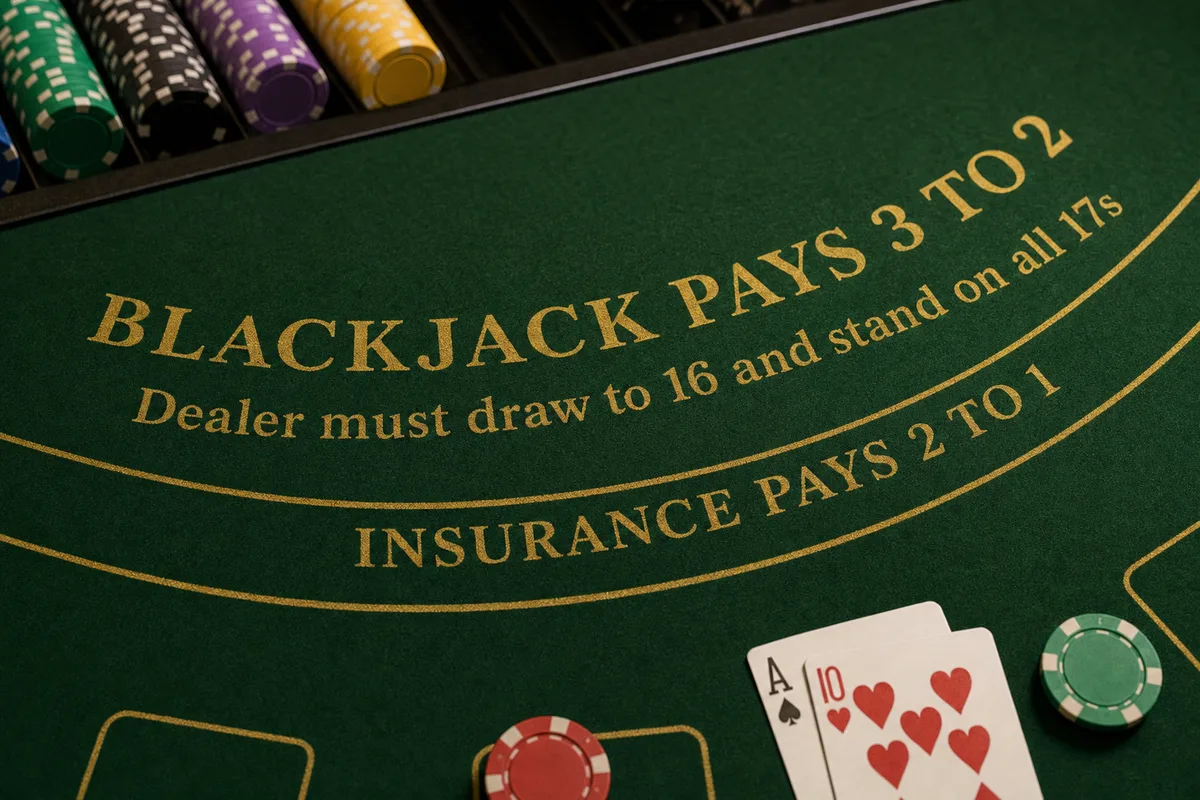
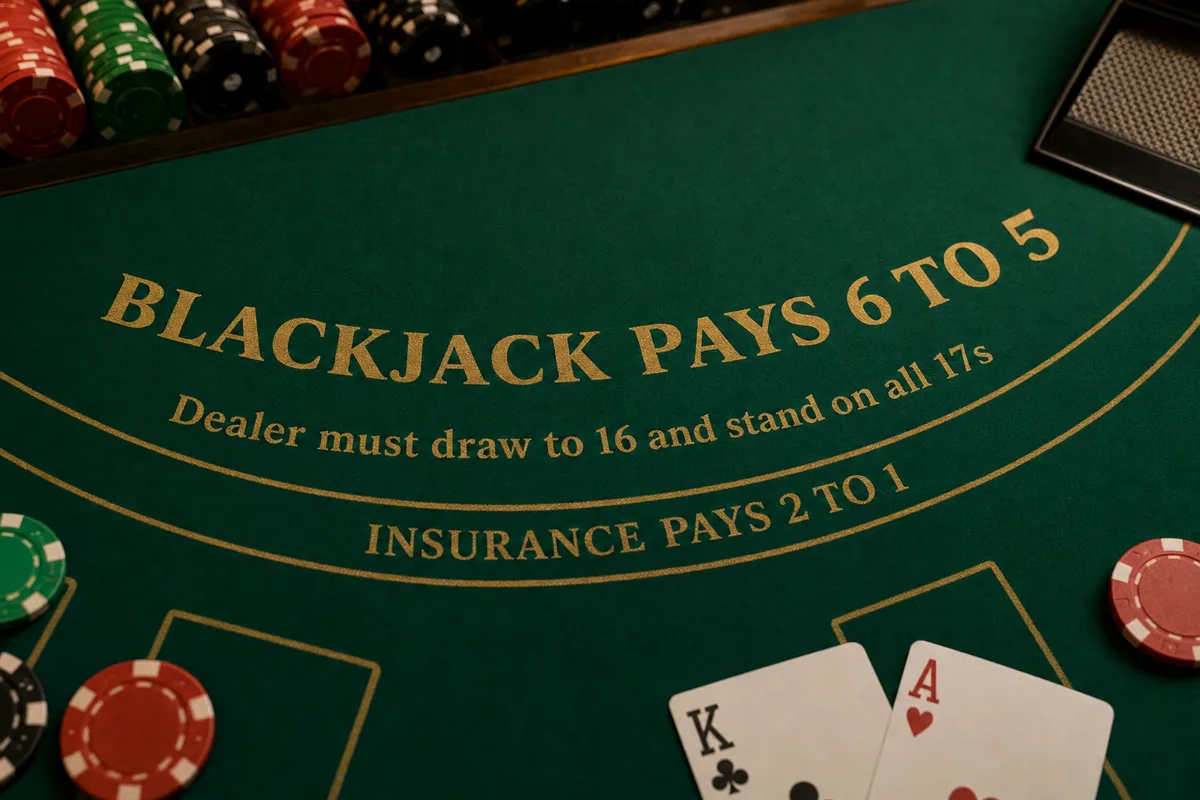
| Your bet | 3:2 pays | 6:5 pays | You lose |
|---|---|---|---|
| $10 | $15 | $12 | $3 |
| $25 | $37.50 | $30 | $7.50 |
| $100 | $150 | $120 | $30 |
It looks small because it only happens on blackjacks. But you get a blackjack about once every 21 hands, and every one of them is paid 20 percent less.
What it does to the house edge
The cost is easy to work out exactly: the chance you get a blackjack that the dealer does not tie, times the 0.3 bets you are shorted.
6:5 adds 1.36% to the house edge in a 6 or 8-deck shoe.
For scale, here is what every other common rule is worth, from 2 billion simulated hands per rule set, played with perfect basic strategy (all the numbers are on blackjack odds):
| Rule change (6 decks) | Adds to house edge |
|---|---|
| Blackjack pays 6:5 instead of 3:2 | +1.36% |
| Dealer hits soft 17 | +0.19% |
| No double after split | +0.14% |
| No late surrender | +0.09% |
| 8 decks instead of 6 | about the same (+0.03%) |
The payout is worth more than all the others put together. If you remember one rule about choosing a table, make it this one.
House edge by table
The shoe games you will actually find. 3:2 figures are simulated (2 billion hands each, splits up to 4 hands, ±0.005%); 6:5 adds the 1.36 percent payout cost.
| Game | 3:2 | 6:5 |
|---|---|---|
| 6 decks, S17, DAS, late surrender | 0.36% | 1.72% |
| 6 decks, S17, DAS | 0.43% | 1.79% |
| 6 decks, H17, DAS, late surrender | 0.55% | 1.91% |
| 6 decks, H17, DAS | 0.64% | 2.00% |
| 8 decks, H17, DAS | 0.66% | 2.02% |
| 8 decks, H17, no DAS | 0.81% | 2.17% |
The worst 3:2 shoe on this list (0.81 percent) is still cheaper than the best 6:5 shoe (1.72 percent). Switch the payout and the same table costs you close to triple.
What 6:5 costs you
Pick your game, your bet and how long you play. Full tables deal around 60 to 80 hands an hour, a heads-up game well over 150.
Average results with perfect basic strategy. Any single session can land far from the average either way.
Counting won’t save a 6:5 game
A good Hi-Lo player gains roughly 0.5 to 1 percent over the house in a 3:2 shoe (see how to count cards). 6:5 takes away more than that, and it shorts you most on the blackjacks that come when the count is high and your bet is biggest. Counters skip 6:5 tables entirely.
No 3:2 table? Play something else
Blackjack sites never say this, but it is just arithmetic. A 6:5 shoe costs about 2 percent. Several games in the same casino cost you less:
| Game | House edge | vs 6:5 blackjack |
|---|---|---|
| Blackjack 3:2 shoe, basic strategy | 0.4 to 0.8% | Much better |
| Full-pay video poker (9/6 Jacks or Better), perfect play | 0.46% | Much better |
| Craps: pass or come line with 3-4-5x odds | about 0.4% | Much better |
| Baccarat: bet the banker | 1.06% | Better |
| Baccarat: bet the player | 1.24% | Better |
| Craps: pass or don’t pass, no odds | 1.36 to 1.41% | Better |
| Blackjack 6:5 shoe | 1.7 to 2.2% | — |
| Roulette, single zero | 2.70% | Worse |
| Three Card Poker (ante and play) | about 3.4% per ante | Worse |
| Roulette, double zero | 5.26% | Worse |
| Slot machines | usually 5 to 10%+ | Much worse |
Baccarat is the easy switch: no decisions, a low edge, and you can bet the banker every hand. Craps with odds is even cheaper if you stick to the pass line and take the odds. Video poker is the cheapest of all, but only on full-pay machines with perfect strategy. The things to avoid are the ones that look like an upgrade: roulette, the poker side tables, and slots.
Of course, the best answer is still a 3:2 blackjack table, where the right basic strategy gets you under 1 percent, and counting can flip the edge to you.
How to spot a 6:5 table
- Read the felt. It says “Blackjack pays 3 to 2” or “Blackjack pays 6 to 5”. Some 6:5 tables print it small, in the arc above the insurance line.
- Check the low-limit tables first. $10 and $15 minimums on busy weekends are where 6:5 lives. If a casino deals single or double deck at all, it is almost always 6:5.
- Know that it varies by casino. 3:2 is still the standard in most casinos outside the Las Vegas Strip, and some Vegas casinos have moved back: the Palms dropped 6:5 entirely in 2025.
- Ask the dealer. “What does blackjack pay?” is a normal question.
- Walk a few tables. Many casinos run 6:5 at the low minimums and 3:2 a few steps away for a slightly higher minimum. At a 1.36 percent difference, the 3:2 table usually costs less per hour even at a higher bet.
Even money and insurance are a separate decision, covered in should you take insurance?, and the right play for any hand is one click away in the blackjack calculator.
Blackjack Logger tracks your real sessions, win or lose, so you can see what a table is costing you.
Set the app to your table's rules and train against the exact chart for that game.
FAQ
What should I play instead of 6:5 blackjack?
First look for a 3:2 table, even at a higher minimum. If there is none, baccarat (bet the banker, 1.06 percent), craps (pass line with odds, about 0.4 percent) and full-pay video poker (0.46 percent with perfect play) all cost less than 6:5 blackjack's 1.7 to 2.2 percent. Roulette, Three Card Poker and slots cost more.
Is 6:5 blackjack worth playing?
Only if there is no 3:2 table available. 6:5 adds about 1.36 percent to the house edge in a shoe game, more than every other common rule combined, and a 3:2 table with a higher minimum usually costs less per hour.
How much does 6:5 blackjack cost?
It pays 20 percent less on every blackjack: $12 instead of $15 on a $10 bet. Over time that adds 1.36 percent to the house edge of a 6 or 8-deck shoe.
What is the house edge of 6:5 blackjack?
About 1.7 to 2.2 percent in a 6 or 8-deck shoe, depending on the other rules, compared with roughly 0.4 to 0.8 percent for the same shoe at 3:2.
Can you count cards at a 6:5 table?
Not profitably in most games. A typical counter's edge at 3:2 is about 0.5 to 1 percent, which is smaller than the 1.36 percent the 6:5 payout takes.
More guides: all blog posts · how to count cards · basic strategy chart · deviations chart